
Service
Mobile alloy wheel refurbishment
Kerbed, scuffed and corroded alloys refinished at your dealership, yard or driveway across the West Midlands — no transport, no downtime.
- 12-month guarantee on the finish
- Fully insured
- Photos before and after every job
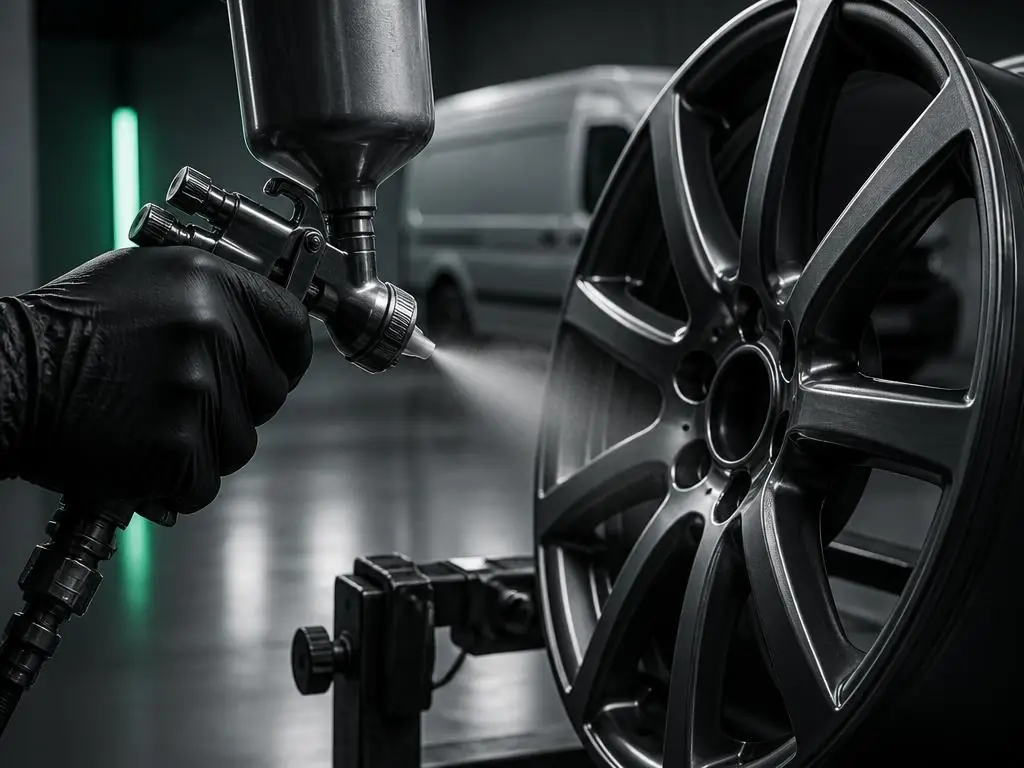
Kerb damage and everyday scuffing
Most of the wheels we see have been caught on a kerb, acar park pillar or a raised drain. The face and outer rim take the damage: the lacquer breaks, the paint or machined surface underneath is torn, and once moisture gets in the edge starts to whiten and lift.
On site we strip the damaged area back, remove any raised metal, fill and level where the alloy has been gouged, then rebuild the finish in colour-matched paint and lacquer. Repaired properly, the edge is sealed again and the wheel stops deteriorating.
Corrosion, lacquer peel and white worm
Older wheels often fail from the inside out. Salt and moisture creep under the lacquer, and you get cloudy patches, flaking clear coat and the fine branching corrosion known as white worm — most common on diamond-cut faces. Painting over it never lasts; the affected coating has to come off and the alloy has to be cleaned back to sound metal before anything new goes on.
We are honest about this one. If corrosion runs across the whole face of every wheel, an on-site repair is cosmetic and short-lived, and we will tell you when a full off-site strip and refinish is the better use of your money.
Diamond-cut effect versus painted finishes
A true diamond-cut wheel is machined on a lathe, which is a workshop process and cannot be reproduced in a van. What we do on site is a diamond-cut effect finish: the wheel is refinished in a two-tone silver or grey over a darker base so it reads correctly against the other three wheels. On a single kerbed wheel in a set, the aim is a match nobody notices in daylight.
Painted finishes — gloss black, satin black, anthracite, shadow chrome, hyper silver, gunmetal and the standard factory silvers — are fully repairable on site and are what most sets are. Colour changes across a full set are also possible when the vehicle is going to be with us for the day.
Colour matching
Wheel colours are matched to the manufacturer's code where one exists, then checked against the actual wheel in daylight, because years of sun and cleaning chemicals move the colour away from the original formula. Where needed the repair is blended out across the spoke or the face rather than stopped at a hard line, so there is no visible edge between old and new.
What can and cannot be repaired on site
We repair kerb scuffs, gouges, scratches, lacquer damage, localised corrosion, faded and mismatched finishes, and refinish full sets.
We do not repair cracked wheels, buckled or out-of-round wheels, wheels with damage to the bead seat or the back of the rim, or wheels that have been heat-damaged. Those are structural and belong with a specialist facility that can weld, straighten and test them. A wheel that holds you on the road is not something to take a chance with, so we will say no and tell you what to look for instead.
How the visit runs and how long curing takes
We need a reasonably level, accessible space next to the vehicle and a few metres of working room. Wheels are usually refinished on the vehicle or on a stand depending on the damage. A single kerbed wheel is typically a couple of hours including preparation, paint, lacquer and forced curing with a portable lamp; a full set is normally the best part of a day.
The lacquer is cured before we leave, so the vehicle can be driven straight away. We do ask that you leave pressure washers, wheel acids and any strong cleaner off the wheels for about a week while the finish fully hardens.
Aftercare
After the first week, wash the wheels with normal car shampoo and a soft brush, avoid acidic wheel cleaners entirely, and rinse off brake dust regularly rather than letting it bake on. Get any fresh kerb damage sealed sooner rather than later — a small chip in the lacquer is a cheap fix, the corrosion it turns into is not.
Get a quote for your wheels
Send clear photos of each damaged wheel plus the vehicle registration. We confirm scope and a date in writing — every job is quoted by enquiry.